 Get ID on WhatsApp
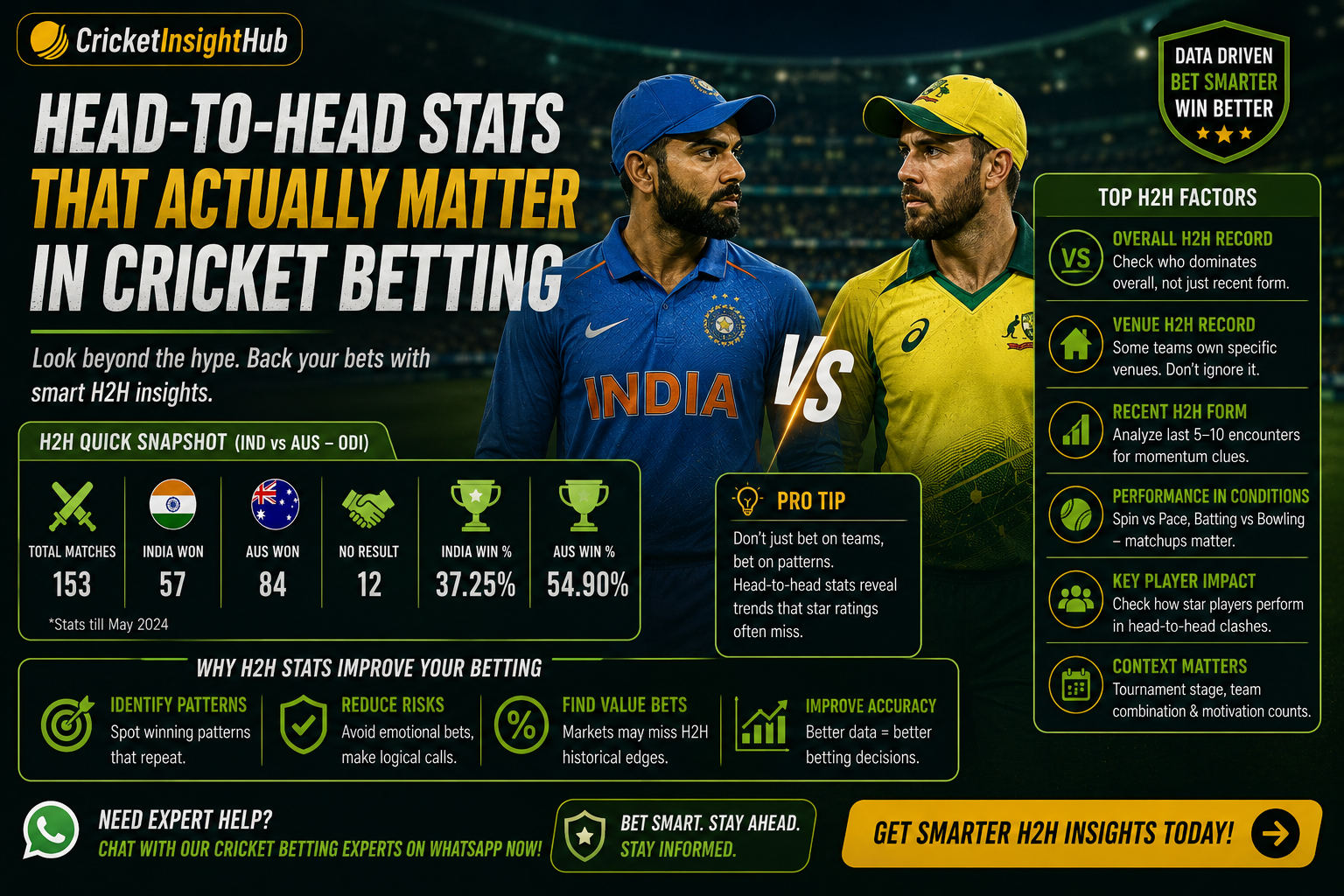
Head-to-Head Cricket Betting is most useful when recent, format-specific H2H results are combined with current team form, playing XI, venue conditions, pitch, weather, and player matchups. The most valuable H2H cricket stats are not simply total wins and losses. Recent meetings, scoring patterns, bowling matchups, venue records, margin of victory, and squad changes can provide more relevant context. Team comparison cricket becomes stronger when historical results are used alongside current evidence rather than treated as a guaranteed prediction.
Cricket teams can have decades of history against each other, but not every previous match deserves equal weight. A result from five years ago may involve completely different players, coaches, strategies, and conditions. Even a recent 4–1 record can be misleading if those matches were played at different venues or under different circumstances. That’s why effective Head-to-Head Cricket Betting analysis isn’t about finding the team with the better historical record and automatically backing it. It’s about understanding which parts of the historical matchup remain relevant to today’s game.
Table of Contents
What Is Head-to-Head Cricket Betting?
Head-to-Head Cricket Betting involves examining previous results between two teams to understand how they have performed against one another. Common data points include:
- Previous wins and losses
- Recent meetings
- Format-specific records
- Average scores
- Wickets taken and lost
- Margin of victory
- Batting and bowling performances
- Venue-specific results
- Chasing and defending records
- Player matchups
- Toss trends
The important distinction is between historical information and current relevance. For example, if Team A has won 16 of 25 previous meetings against Team B, that tells you something about their history. It doesn’t automatically tell you which team is stronger today. Current players, injuries, playing conditions, tactics, venue, and recent form can completely change the matchup.
Why H2H Records Can Be Misleading
A headline such as “Team A has won 70% of previous meetings” looks impressive, but the number needs context. Ask yourself:
- When did those matches take place?
- Which format were they played in?
- Where were they played?
- Which players participated?
- Were important players missing?
- Were the teams equally strong?
- Have the coaches or captains changed?
- Are today’s conditions similar?
This is why Historical match records should normally be treated as supporting evidence rather than a standalone prediction. An old record can explain the history between two teams, but it may not accurately describe the current matchup.

1. Start With Recent H2H Results
The most useful place to begin is usually the recent head-to-head record. Look at the last several relevant meetings and examine:
- Winner
- Margin of victory
- First-innings score
- Successful chase
- Wickets lost
- Key batting performances
- Key bowling performances
- Venue
- Match format
- Playing XI
Recent H2H results can show whether one team has recently handled the matchup better. However, don’t stop at the win-loss record. A team winning four consecutive games could have benefited from a particular venue, exceptional individual performances, or repeated weaknesses in the opposition lineup. The result matters, but understanding why the result happened matters more.
2. Separate T20, ODI and Test H2H Records
One of the biggest mistakes in Cricket betting statistics is combining different formats. T20, ODI, and Test cricket require different skills and strategies. A team’s excellent Test record against an opponent doesn’t necessarily provide useful information for a T20 match. For better analysis, compare:
- T20 vs T20
- ODI vs ODI
- Test vs Test
For T20 cricket, pay particular attention to powerplay batting, death bowling, strike rates, six-hitting, spin matchups, and finishing ability. For ODIs, examine innings construction, middle-over wickets, partnerships, pace-spin balance, and chasing performance. Format-specific H2H data is therefore much more relevant than one combined historical record.
3. Look at the Margin of Victory
Win-loss records don’t tell you how competitive previous matches were. Compare:
- Runs margin
- Wickets margin
- Balls remaining
- Super Overs
- Final-over finishes
- Comfortable victories
- Heavy defeats
Consider two teams with a 6–4 H2H record. In one matchup, most wins may have come comfortably. In another, eight of the ten games could have gone down to the final few overs. Those are completely different competitive profiles. Margin of victory helps reveal whether the historical advantage has been dominant or relatively narrow.
4. Analyze Scoring Patterns
Average scores can help explain how previous matches developed. Useful H2H cricket stats include:
- Average first-innings score
- Average successful chase
- Highest score
- Lowest score
- Average wickets lost
- Powerplay scoring
- Middle-over scoring
- Death-over scoring
- Typical winning totals
But don’t rely on averages alone. Suppose the average first innings is 175. That doesn’t tell you whether most scores fall between 165 and 185 or whether the venue regularly produces both 130 and 220. Score distribution and recent results can provide additional context.
5. Compare Current Batting Lineups
This is where Team comparison cricket becomes more useful than a simple historical record. Instead of asking only “Which team has won more H2H matches?”, ask:
- Which team has the stronger opening pair?
- Which middle order is more consistent?
- Who handles pace better?
- Who handles spin better?
- Which team has better death-over hitters?
- Which side rotates the strike more effectively?
- Which batters are currently in form?
A historical H2H advantage may become less important if the current batting units are completely different.
6. Analyze Bowling Matchups
Bowling matchups can explain why one team has historically troubled another. Look at:
- Powerplay wickets
- Middle-over economy
- Death-over economy
- Pace vs spin performance
- Wickets against key batters
- Boundary percentage conceded
- Strike rate
- Recent bowling form
For example, if Team A’s current bowling attack has multiple quality spinners and Team B’s middle order historically struggles against spin, that matchup may be more relevant than a five-year-old overall H2H record.
7. Study Venue-Specific H2H Records
The location of the match can significantly change the relevance of historical data. A team might have a poor overall record against an opponent but perform well at the current venue. Examine:
- H2H results at the venue
- Average first-innings score
- Chasing success
- Pace performance
- Spin performance
- Boundary dimensions
- Recent matches at the ground
Venue data becomes especially useful when combined with the current pitch and weather. Don’t assume that a historical venue advantage will automatically continue if the surface or team composition has changed.
8. Compare the Current Squads With Historical Teams
This is one of the most important parts of Head-to-Head Cricket Betting. Historical results represent previous versions of the teams. Today’s match involves today’s players. Ask:
- Are the main batters still playing?
- Are the same bowlers available?
- Has the captain changed?
- Has the coach changed?
- Has the batting order changed?
- Are key players injured?
- Are players being rested?
- Has the team’s tactical approach changed?
The more the current teams differ from the historical teams, the less weight older H2H results should generally receive.
9. Check Player-vs-Player Matchups
Team-level H2H statistics become more useful when you investigate individual matchups. For example:
Batter vs Bowler
- Runs scored
- Balls faced
- Dismissals
- Strike rate
Batter vs Bowling Type
- Pace
- Spin
- Left-arm pace
- Right-arm pace
Bowler vs Batting Phase
- Powerplay
- Middle overs
- Death overs
These patterns can help explain how the matchup may develop. However, small samples should be treated cautiously. A batter’s record against one bowler over only a few innings shouldn’t automatically outweigh current form and broader performance.
10. Look Beyond Who Won
A common H2H mistake is recording only the winner. Suppose Team A won the previous match. That doesn’t tell you everything. Maybe:
- Team B scored 195
- Team A needed the final over to win
- One player produced an unusually large innings
- Team B lost three wickets in the powerplay
- A dropped catch changed the result
Understanding the match process can be more valuable than simply recording the final result. The question should be: What caused the historical result, and is that factor still present today?

11. Consider Toss and Batting-Order Patterns
Toss data can provide additional context, particularly in limited-overs cricket. Review:
- Toss winner
- Decision after winning
- Batting-first results
- Chasing results
- Day vs night matches
- Dew conditions
However, don’t treat toss results as a guaranteed advantage. Winning the toss only becomes meaningful when the conditions make one tactical choice more favourable.
12. Give Current Form More Weight When Squads Have Changed
H2H answers: How have these teams performed against each other? Current form answers: How are these teams performing now? Both questions matter. But if the squads have changed significantly, recent form can become more informative than older H2H results. Review:
- Last five matches
- Batting consistency
- Bowling performance
- Powerplay results
- Death-over performance
- Chasing ability
- Recent individual performances
A team with a poor historical H2H record can still enter the match as the stronger current side.
13. Check Player Availability Before Using Historical Data
Team strength can change quickly. Before relying heavily on Cricket betting statistics, check:
- Injuries
- Suspensions
- Rested players
- International commitments
- Squad rotation
- Replacement players
- Expected playing XI
If a team’s historical success depended heavily on players who aren’t available today, that historical record deserves less weight. This is particularly important in franchise cricket, where overseas availability and squad combinations can change frequently.
14. Consider the Quality of Previous Matches
Not every H2H result provides the same level of information. Consider:
- Strength of previous playing XI
- Missing players
- Tournament stage
- Venue
- Match importance
- Current squad strength
For example, a recent win against a heavily weakened opposition lineup shouldn’t necessarily carry the same weight as a win against the opponent’s strongest XI. Context determines relevance.
15. Use H2H to Explain the Matchup, Not Guarantee the Result
A weak analytical statement is: “Team A has won seven of the last ten, so Team A should win.” A stronger approach is: “Team A has won seven of the last ten meetings, but most of those games were played at venues where its bowling attack performed particularly well. The current match is at a different venue, while Team B now has a stronger batting lineup against that bowling style.” The second approach explains why the historical statistic may or may not matter today. That’s the real value of H2H analysis.
16. Build a Simple H2H Comparison Framework
Before a match, compare the teams across several categories:
- Recent H2H
- Current form
- Batting strength
- Bowling strength
- Venue record
- Chasing record
- Pace matchup
- Spin matchup
- Key player availability
- Player matchups
The purpose isn’t to automatically select the team with the most favourable categories. Instead, identify which factors are most relevant to the current match.
17. Give More Weight to Relevant Evidence
A practical evidence hierarchy can help prevent outdated statistics from dominating your analysis.
High relevance
- Current playing XI
- Recent form
- Current pitch
- Current venue conditions
- Player matchups
- Recent H2H
Medium relevance
- Longer-term venue records
- Historical H2H
- Toss trends
- Older player records
Lower relevance
- Very old matches
- Different formats
- Results involving completely different squads
- Very small samples
This doesn’t mean older data is useless. It simply means historical information should be weighted according to its relevance.
18. Watch Out for Small-Sample H2H Trends
Small samples can create impressive-looking statistics. For example:
- A batter averages 80 against one team over three innings
- A team has won three consecutive meetings
- A bowler has dismissed a batter twice
- A team has won every match at one venue
These numbers can be interesting, but they don’t necessarily represent a reliable long-term pattern. Always consider sample size before giving a statistic significant weight.
19. Don’t Confuse Correlation With Causation
A strong H2H record doesn’t automatically explain why one team has been successful. The reason could be:
- Better players
- Stronger bowling
- Home conditions
- Tactical advantages
- Weak opposition lineups
- Particular venues
- Historical squad quality
The H2H record tells you what happened. Your job as an analyst is to investigate why it happened and whether the same conditions exist today.
20. Use a Repeatable H2H Analysis Process
A consistent process can make cricket research more structured.
Step 1: Identify the format
Separate T20, ODI and Test records.
Step 2: Review recent H2H
Focus on relevant recent meetings.
Step 3: Check current form
Compare recent team and player performances.
Step 4: Check squad availability
Identify injuries, rotation and expected playing XI.
Step 5: Analyze venue conditions
Consider pitch, boundaries, weather and dew.
Step 6: Compare batting units
Identify strengths and weaknesses.
Step 7: Compare bowling attacks
Study pace, spin, powerplay and death performance.
Step 8: Study player matchups
Look for relevant batter-bowler patterns.
Step 9: Review historical records
Use older Historical match records for context.
Step 10: Assess relevance
Determine which historical patterns still apply to today’s match.
Common Mistakes When Using H2H Cricket Stats
- Relying Only on Win Percentage: A 70% H2H record doesn’t automatically represent a 70% chance of winning the next match.
- Mixing Different Formats: T20, ODI and Test results shouldn’t normally be combined into one H2H prediction.
- Ignoring Squad Changes: Historical teams may have little resemblance to the current playing XI.
- Ignoring Venue: A matchup can behave differently at different grounds.
- Overvaluing Small Samples: Three matches can create misleading patterns.
- Ignoring Current Form: Recent performances can reveal changes that historical data cannot.
- Treating H2H as a Guarantee: Statistics describe previous outcomes. They don’t determine future results.

How to Use H2H Data More Effectively
Think of H2H statistics as a context layer rather than the foundation of your entire analysis. A stronger framework combines:
- H2H
- Current form
- Playing XI
- Venue
- Pitch
- Weather
- Player matchups
When several independent factors point in a similar direction, the overall analysis becomes more informative. When H2H conflicts with current form or venue conditions, don’t automatically follow the historical record. Investigate why the signals disagree. That is often where the most useful analytical insight comes from.
How CricketInsightHub Can Approach H2H Research
For readers researching cricket markets, CricketInsightHub can use Head-to-Head Cricket Betting data as one part of a broader evidence-based research framework. Instead of presenting historical records as guaranteed indicators, H2H information can be evaluated alongside:
- Current team form
- Playing XI
- Player availability
- Venue conditions
- Pitch characteristics
- Weather
- Batting matchups
- Bowling matchups
- Recent performance
This approach helps distinguish historical trends from current evidence and gives readers a more balanced way to understand why two teams have produced certain results in the past.
Frequently Asked Questions
What is Head-to-Head Cricket Betting?
Head-to-Head Cricket Betting involves analyzing previous results between two teams to understand historical matchup patterns. Useful analysis goes beyond wins and losses and considers format, venue, recent results, squad changes and player matchups.
Which H2H cricket stats matter most?
The most useful H2H cricket stats generally include recent meetings, format-specific results, scoring patterns, venue records, bowling performances, player matchups, margins of victory and current squad relevance.
Should old Historical match records be used?
Yes, but mainly as context. Older Historical match records become less relevant when players, coaches, tactics, venues or playing conditions have changed substantially.
Why is Team comparison cricket important?
Team comparison cricket moves beyond historical results by examining current batting strength, bowling quality, player availability, recent form and matchup-specific strengths and weaknesses.
Are Cricket betting statistics enough to predict a match?
No. Cricket betting statistics can support research, but they cannot guarantee an outcome. Current form, playing XI, pitch, venue, weather and player matchups should also be considered.
How many H2H matches should I analyze?
There is no universal number. Start with recent relevant meetings and then use longer-term records for context. Always consider sample size, format, venue and how much the teams have changed.
Final Thoughts
Head-to-Head Cricket Betting is most useful when historical results are treated as evidence rather than certainty. Start with recent H2H meetings. Separate T20, ODI and Test records. Examine scoring patterns and margins of victory. Compare venue-specific results. Study current batting and bowling matchups. Check player availability and current form. Then use longer-term Historical match records to provide additional context. The biggest mistake is assuming that past dominance automatically creates a present advantage. Cricket teams evolve, players change, venues behave differently, and match conditions can shift from one game to another. For stronger Team comparison cricket, the goal should be to understand why a historical pattern existed and whether the same conditions are present today. When H2H cricket stats, current form, venue conditions, player availability and matchup data support the same conclusion, the analysis becomes more structured and useful. That’s where Cricket betting statistics have their greatest value—not as guarantees of future results, but as tools for understanding the factors that can shape a cricket match.
Also Read –
Understanding Reverse Line Movement in Cricket Betting
What Are the Most Common IPL Betting Mistakes?
What Should You Check Before Using a Cricket Betting App in India?
How to Choose a Safe Online Cricket Betting App
What Is a Cricket Betting ID and How Is It Used?
Fantasy Cricket Tips Today: Mumbai vs Chennai Dream11 Predictions & Pitch Report Guide